
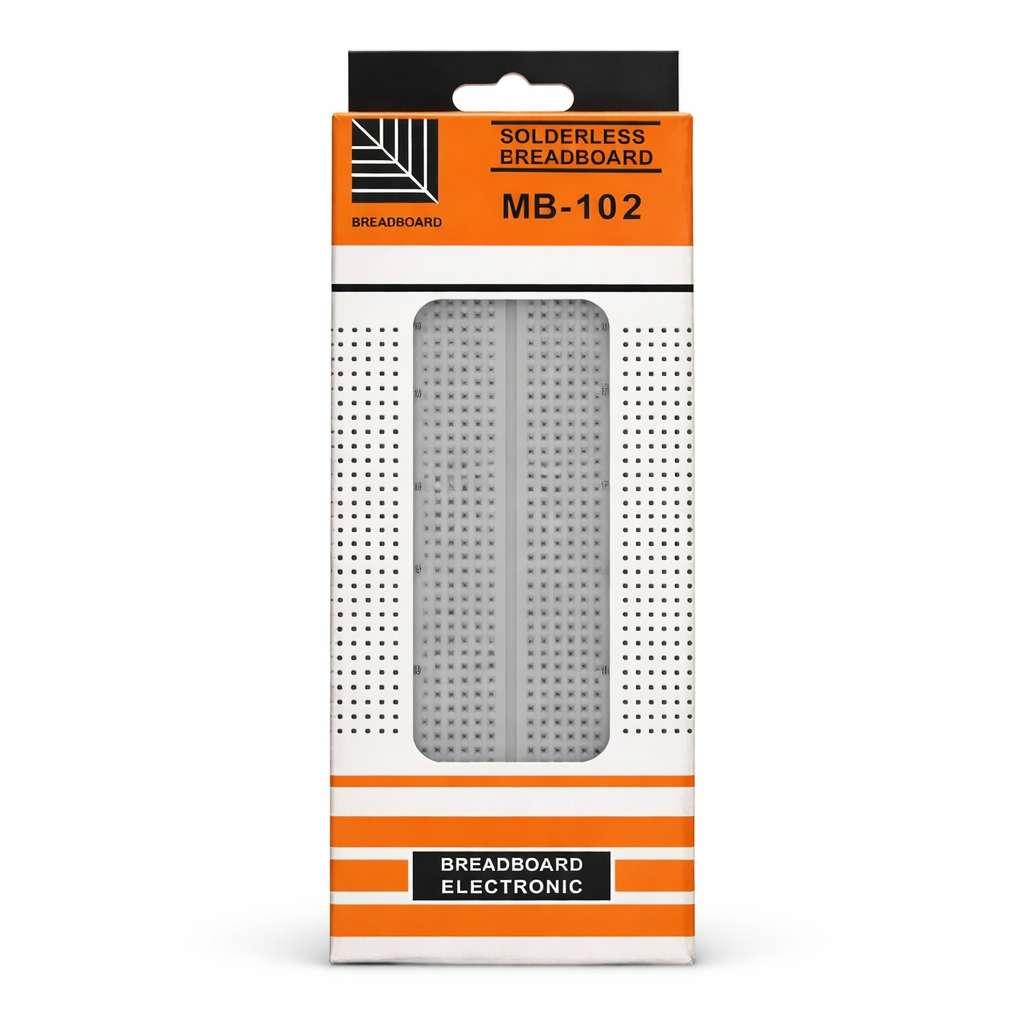
Solderless Breadboard for Arduino & Circuit Prototyping
The solderless breadboard is a reusable electronic prototyping board designed for building, testing and modifying circuits without soldering. This MB102 breadboard provides 830 tie points, giving you a convenient workspace for assembling electronic circuits using jumper wires and compatible components.
A breadboard is especially useful during the development stage of a project because components can be inserted, removed and rearranged without permanently joining them together. This makes it easier to test different circuit designs, troubleshoot connections and make changes as your project develops.
The MB102 is suitable for Arduino projects, robotics, electronics learning, DIY circuits and general prototyping.
Key Features
| Feature | Details |
|---|---|
| Model | MB102 |
| Type | Solderless breadboard |
| Total tie points | 830 |
| Terminal points | 630 |
| Power distribution points | 200 |
| Hole spacing | 2.54 mm / 0.1 inch |
| Soldering | Not required |
| Application | Electronic circuit prototyping |
830 Tie Points for Circuit Prototyping
With 830 tie points, this MB102 board provides plenty of connection points for developing electronic circuits. The main terminal area can be used for placing components, while the power distribution rails help organise power connections across the board.
The 2.54 mm (0.1-inch) spacing is designed for common through-hole electronic components and jumper wires, making the board convenient for many electronics projects.
Because it is solderless, you can change the arrangement of your circuit without permanently modifying the components or board.
Easy Circuit Building Without Soldering
One of the main advantages of a solderless breadboard is the ability to experiment with circuits quickly. Instead of soldering components together during the testing stage, you can plug them into the board and use jumper wires to create the required connections.
This makes the MB102 useful when:
- Testing a new circuit design
- Troubleshooting electronic connections
- Changing component arrangements
- Learning basic electronics
- Developing prototypes before PCB assembly
Ideal for Arduino & Robotics Projects
The MB102 can be used alongside Arduino boards and other development hardware for a wide range of electronics projects. It provides a practical platform for connecting components such as LEDs, resistors, sensors, integrated circuits and jumper wires during circuit development.
It is also useful for robotics enthusiasts who need to test connections between microcontrollers, sensors and other electronic modules before creating a permanent circuit.
For more components for electronics and robotics projects, explore our Electronics & Accessories and Robotics & Tools categories.
Common Applications
The solderless breadboard can be used for:
- Arduino circuit prototyping
- Robotics projects
- Sensor experiments
- LED circuits
- Microcontroller projects
- Electronics training
- DIY electronic projects
- Circuit testing
- Circuit troubleshooting
- Prototype development
Technical Specifications
| Specification | Details |
|---|---|
| Product | MB102 Solderless Breadboard |
| Total tie points | 830 |
| Terminal points | 630 |
| Power distribution points | 200 |
| Hole pitch | 2.54 mm / 0.1 inch |
| Design | Solderless |
| Primary use | Electronic circuit prototyping |
Package Includes
| Item | Quantity |
|---|---|
| MB102 830 Tie Point Solderless Breadboard | 1 |
A Practical Board for Electronics Prototyping
The solderless breadboard provides a simple and reusable way to build and test electronic circuits without soldering. With 830 tie points, standard 2.54 mm spacing and a convenient layout for component and jumper-wire connections, the MB102 is a practical choice for Arduino projects, robotics, electronics learning and DIY circuit development.
Whether you are experimenting with your first circuit or testing a design before moving to a permanent PCB, this breadboard gives you the flexibility to make changes quickly and reuse the board for future projects.
For more information about breadboards and Arduino prototyping, see the Arduino breadboard resources



 No products in the cart.
Reviews
There are no reviews yet.