
If you’re looking into electronics, robotics, or programming for the first time, an Arduino UNO starter kit is usually one of the first practical tools people recommend — and for good reason. Instead of buying a board and then hunting down sensors, wires, and modules one at a time, a starter kit gives you a working collection of parts you can begin experimenting with straight away.
This guide walks through what’s actually included in the Viroh Store Arduino UNO kit, what each part is generally used for, and what kind of projects you can realistically build as you learn.
What Is an Arduino UNO Starter Kit?
An Arduino UNO starter kit combines an Arduino UNO-compatible development board with a set of sensors, modules, and basic electronics components, so a beginner can start building and testing circuits without sourcing each item separately.
The board itself handles the programming and logic side — you write code, upload it to the board, and the board reads sensors or controls outputs based on that code. The rest of the kit gives you the physical building blocks: things that sense light, temperature, motion, or sound, and things that respond — motors, displays, LEDs, buzzers.
The board in this kit is an ATmega328P-based UNO R3, with a CH340G USB-to-serial interface — the standard, widely documented Arduino UNO chipset.
What Comes in the Viroh Store Arduino UNO Kit?
Rather than dumping every part into one long list, here’s what’s included, grouped by what it’s actually for.
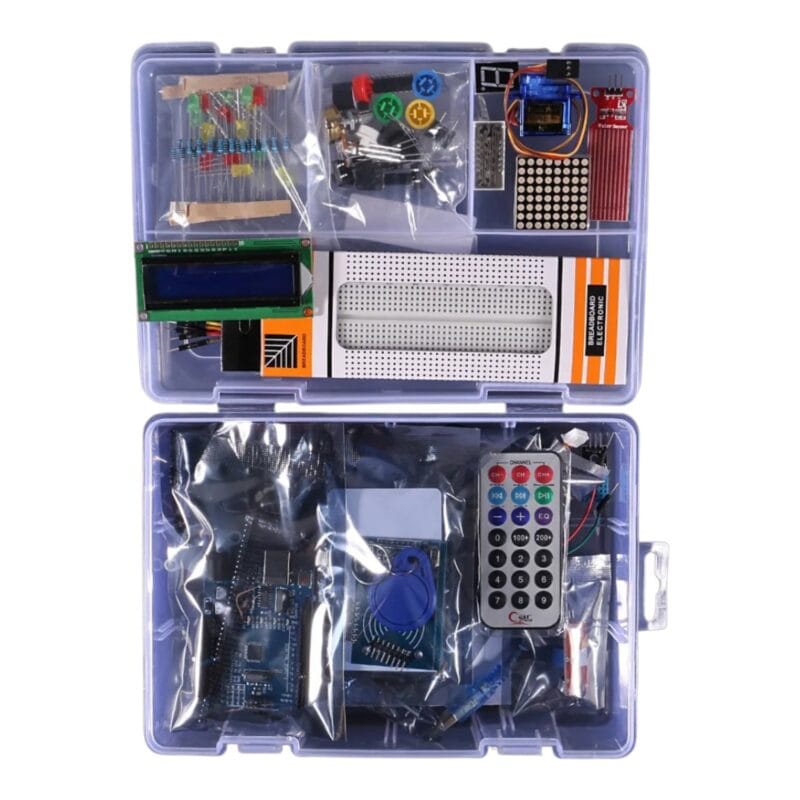
Arduino Board and Programming Essentials
| Component | Details |
|---|---|
| Arduino UNO-compatible board | ATmega328P-based UNO R3, CH340G USB interface |
| USB cable | 50 cm |
| Breadboard | 830-point |
| Jumper wires | 30 pieces, plus male-to-female wires |
| 2.54mm pin header | Included |
| Resistor card | Included |
Sensors and Input Modules
| Component | Use |
|---|---|
| DHT11 module | Temperature and humidity |
| Water sensor | Detects presence of water/moisture |
| KY-037 sound sensor | Detects sound levels |
| Photoresistor (5528) | Light-level detection |
| LM35 | Temperature sensor |
| Tilt switch | Detects orientation/movement |
| 4×4 matrix keypad | Manual input |
| Joystick module | Directional input |
| 10K potentiometer | Adjustable analog input |
| Push button + button cap | Basic input |
Displays and Output Components
| Component | Use |
|---|---|
| 1602 LCD module | Text display |
| 4-digit 7-segment display | Numeric display |
| 1-digit 7-segment display | Numeric display |
| 8×8 LED matrix | Pattern/graphic display |
| RGB module | Colour output |
| Green, red, and yellow LEDs | Basic indicator lights |
Motors and Motion Components
| Component | Use |
|---|---|
| 5V stepper motor | Precise rotational movement |
| ULN2003 driver board | Controls the stepper motor |
| 9g servo motor | Controlled rotational movement |
RFID, Remote Control, and Communication Components
| Component | Use |
|---|---|
| RC522 RFID module + RFID card and key tag | Card/tag reading |
| IR receiver module | Reads infrared signals |
| Remote control | Sends IR signals to the receiver |
| DS1302 module | Real-time clock |
Buzzers, Buttons, and Basic Electronics
| Component | Use |
|---|---|
| Active buzzer | Fixed-tone sound |
| Passive buzzer | Programmable-tone sound |
| 220Ω, 1K, and 10K resistors | Circuit protection/current control |
| 74HC595 IC | Shift register for controlling multiple outputs |
| 5V relay | Switches higher-power devices |
Power and Connection Accessories
| Component | Details |
|---|---|
| 9V battery connector | For external power |
| 9V block battery | Added by Viroh Store |
| DC mini motor | Added by Viroh Store |
The last two items — the 9V block battery and the DC mini motor — aren’t part of the standard manufacturer packaging. Viroh Store adds them to the kit as a value addition, so you’re not left needing to source a battery or a basic motor separately before you can start testing power-related projects.
What Can You Build With an Arduino UNO Kit?
The components in this kit cover a wide range of beginner and intermediate projects. Some can be built entirely from what’s included; others give you a starting point but may need extra parts, programming logic, or an external power source depending on how far you take them.
Realistic starting projects include:
- Temperature and humidity monitoring using the DHT11
- A basic water-detection alert using the water sensor
- Simple RFID access demonstrations using the RC522 module
- Light-based projects using the photoresistor
- A digital counter using the 7-segment displays
- Text-based readouts using the 1602 LCD
- Sound-triggered responses using the KY-037 sensor
- Motion or tilt-based alerts using the tilt switch
- Remote-controlled LED or buzzer responses using the IR receiver and remote
- Joystick-controlled outputs
- Basic relay-controlled switching demonstrations
- Servo and stepper motor movement experiments
An RFID access-control demo, for example, is a common early project — the RC522 module reads a card or tag, and your code decides how to respond, such as lighting an LED or sounding the buzzer when a valid tag is scanned. The kit includes an RFID card and key tag, so you can test scanning straight away without sourcing your own. It’s a practical way to understand how input and output logic connects.
It’s worth being upfront that some of these ideas — a full home automation system, for instance — would need more components, a stronger power supply, or additional programming knowledge than a single kit provides on its own. This kit gives you the building blocks to learn the fundamentals and prototype ideas, not a finished product for every application.
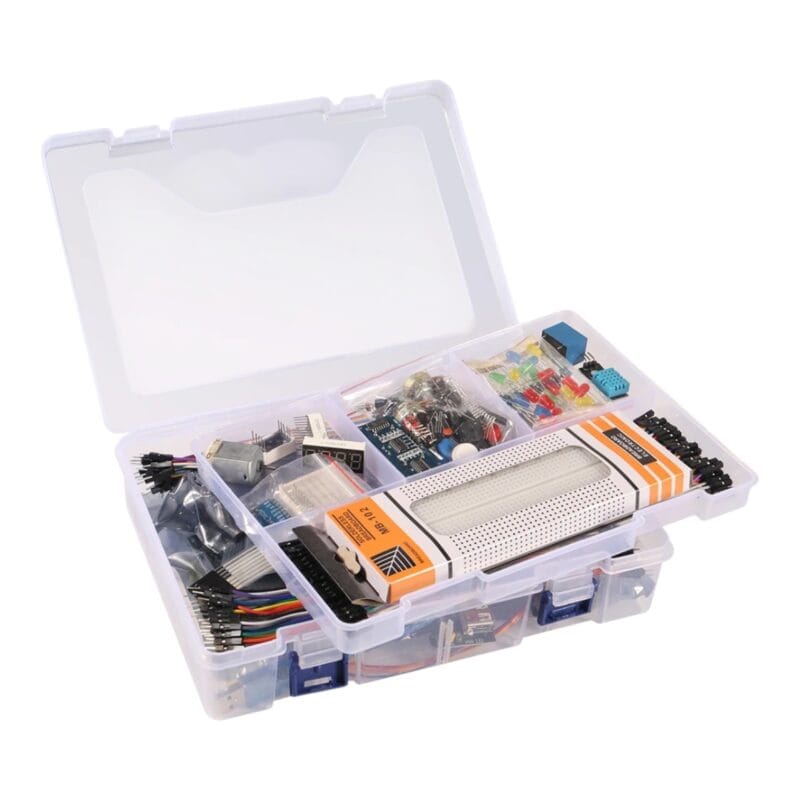
Why This Kit Is Useful for Beginners
The value of a kit like this isn’t the number of parts — it’s that you can move from one small experiment to the next without buying anything new each time. You might start by making an LED blink, then move to reading a sensor, then combine a sensor with a display, and gradually build toward something more complex.
That progression — small working experiment, then the next one — tends to teach programming and electronics logic faster than reading theory alone.
Who Should Buy an Arduino UNO Starter Kit?
This kit is a reasonable fit for:
- Students learning electronics or programming
- Teachers preparing practical lessons
- Robotics clubs and hobbyists
- Engineering students working on prototypes
- Schools and training centres building out an electronics lab
- Resellers supplying kits to learners
Retail and Wholesale Arduino Kit Supply in Kenya
Viroh Store sells this kit both individually and in bulk. If you’re a student or hobbyist buying one kit for personal projects, it’s available as a standard retail purchase. Schools, colleges, training centres, and resellers looking to equip a class or a lab can contact Viroh Store directly to enquire about wholesale quantities.
Why the Viroh Store Kit Offers Extra Value
Beyond the standard component set, Viroh Store includes a 9V block battery and a DC mini motor with every kit. These aren’t part of the original manufacturer’s packaging — they’re added specifically so you have a working power source and a basic motor on hand without needing a separate purchase before you can start testing.
Where to Get the Arduino UNO Starter Kit
If your project specifically needs built-in Wi-Fi or Bluetooth — for IoT or wireless projects, for example — the ESP32 Starter Kit may be a better fit than the Arduino UNO.
You can check the Arduino UNO Starter Kit product page for the current price, availability and delivery information.
For individual components, sensors, or boards outside the kit, the Electronics & Accessories and Robotics & Tools categories carry a wider selection.
For programming references and setting up your development environment, Arduino’s official documentation is a reliable starting point for understanding how the board and IDE work together.
Frequently Asked Questions
What is an Arduino UNO starter kit?
It’s a bundle combining an Arduino UNO-compatible board with sensors, modules, and basic components, so you can start building circuits without buying each part separately.
What is included in the Viroh Store Arduino UNO kit?
An ATmega328P-based UNO R3 board, breadboard, a range of sensors and displays, a stepper motor and servo, an RFID module, jumper wires, resistors, LEDs, buzzers, and a 9V battery and DC mini motor added by Viroh Store.
Is this kit suitable for beginners?
Yes. You don’t need prior experience — starting with simple experiments like an LED or a single sensor is a normal way to begin.
Does the kit include an RFID module?
Yes, an RC522 RFID module is included, along with an RFID card and key tag, so you can test scanning immediately without sourcing your own.
Does Viroh Store offer wholesale Arduino kits?
Yes, schools, training centres, and resellers can contact Viroh Store to enquire about bulk pricing.